top of page
Dana Goh
Statement
My practice begins with the garden as a metaphor for identity. The garden I tend is an internal one, where identity is not fixed but continuously cultivated. Some things are inherited, others chosen. Some take root, while others fade or return in unexpected forms.
Drawing on Olivia Laing’s The Garden Against Time, I think of plants as travellers in space and time. Seeds can lie dormant for years before taking root in new ground, and many plants we associate with a place arrived there from elsewhere. Born in Singapore, raised in Vienna and now living in London, I am drawn to these journeys. My work explores what we carry and what we keep, and how the foreign becomes familiar.
Each artwork is a seed gathered from my own garden. It begins with a feeling, memory or question I want to understand at a particular moment. Giving it physical form holds that moment in place while I continue to change, so the work becomes a time capsule of an earlier self.
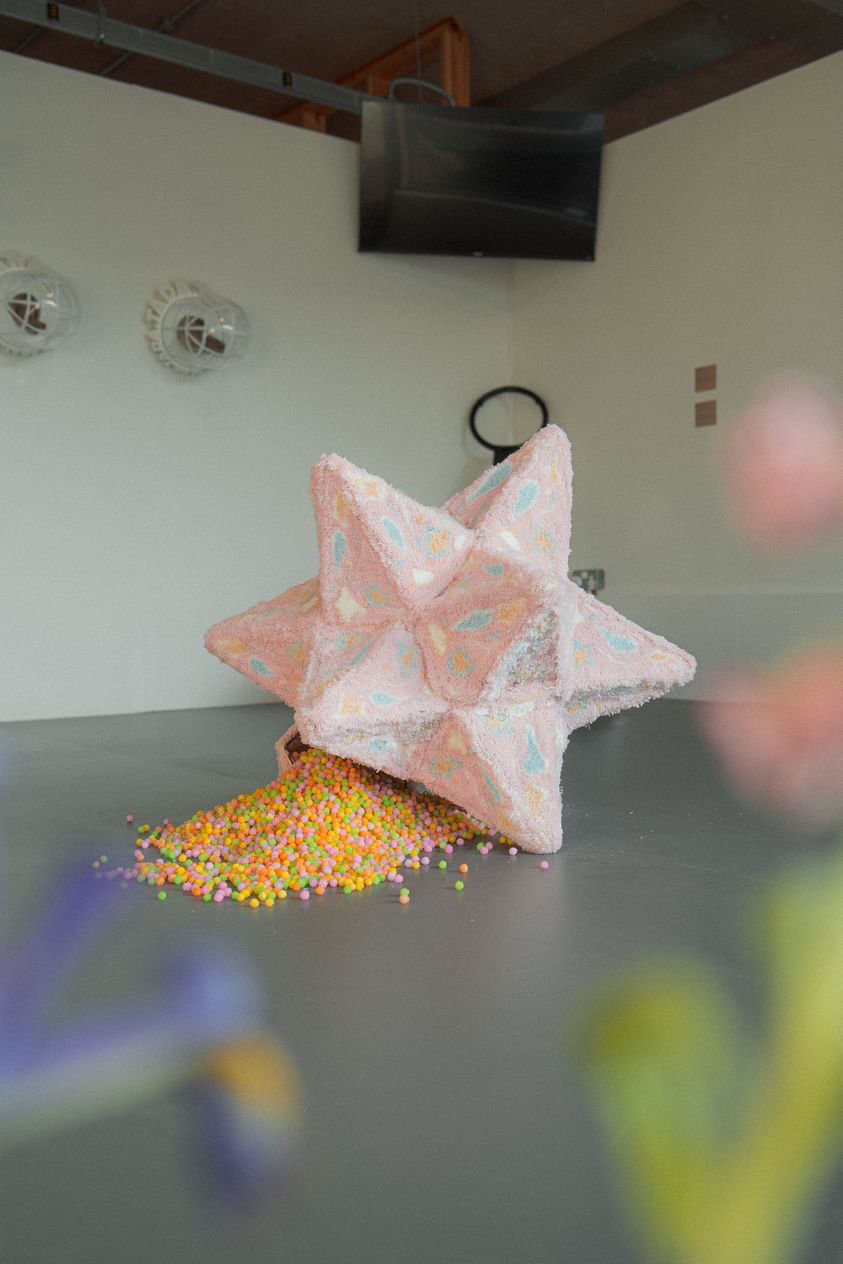
I draw on decorative arts traditions from both Asia and Europe, including textiles, beadwork and stained glass. Ornament has always travelled, and many motifs that feel local have mixed origins. Within my work, botanical forms from Singapore, Southeast Asia, East Asia and Vienna are selected, altered and replanted side by side.
Texture and feeling are central throughout. Through slow, attentive making, intangible experiences acquire weight, colour and form, becoming objects that are met through the body rather than read only as images.
Dana Goh
Dana Goh (b. 2001, Singapore) is a London-based multidisciplinary artist whose practice draws on decorative arts traditions, including textiles, beadwork and stained glass. Hers is a tactile practice: texture and touch are central to how her work is made and how it is felt. Goh explores identity as something living and continually changing. Through the metaphor of the garden, she gives physical form to memories, emotions and questions drawn from different moments in her life, translating inner experience into surfaces that invite closeness and feeling.
Goh graduated with a BA (Hons) in Fine Art from Newcastle University in 2023 and an MA in Contemporary Art Practice from the Royal College of Art in 2024. Her work has been exhibited internationally in London, New York, Vienna, Newcastle upon Tyne, Liverpool, Shanghai, Singapore and Seoul. She was a finalist for the VAO UK & International Emerging Artist Award in the Young Artist category (2024), was selected for the Emerging Woman Artist Award (2024), and was longlisted for the Aesthetica Art Prize (2025). She is also the founder and creative director of Qloud.
bottom of page